Build a Powerful n8n AI Agent with Model Context Protocol (MCP)
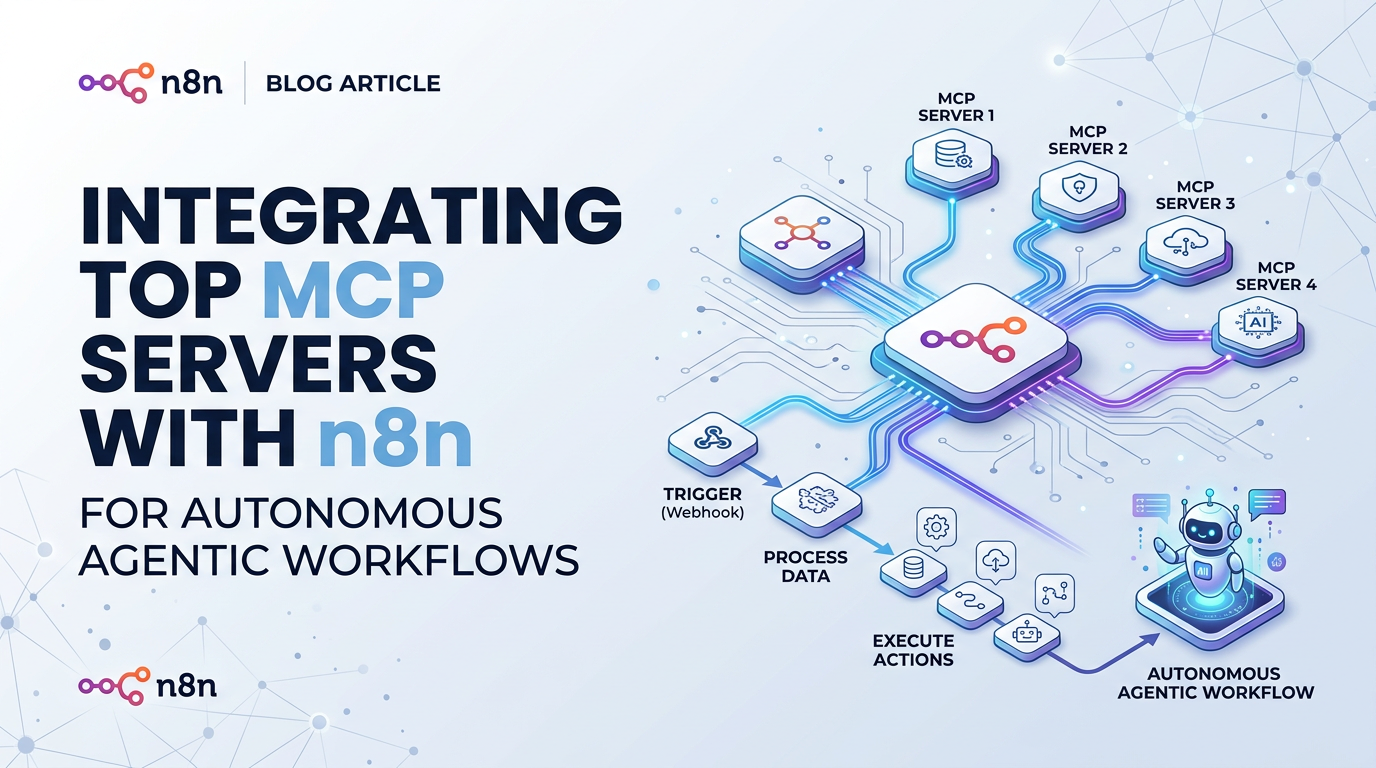
In today’s fast-paced development landscape, building systems that are reliable, scalable, and automated is critical. Developers require tools that integrate seamlessly with diverse backend infrastructures while simplifying complex workflows. A powerful solution emerges from combining the Model Context Protocol (MCP) with n8n. By configuring a specialized n8n AI agent, developers can design autonomous systems that execute production-level tasks efficiently, bridging the gap between large language models and your private data. This article explores the benefits, features, and practical examples of integrating MCP servers with n8n for effective orchestration. The Role of Model Context Protocol in Advanced n8n AI Agents By utilizing the Model Context Protocol, MCP servers provide a harmonized environment where multiple servers deliver on-demand computing resources. Serving as the backbone of modern production environments, MCP servers manage requests, allocate resources, and ensure applications remain responsive under varying loads. For developers, MCP servers represent advanced infrastructure management offering robust, secure, and adaptable solutions across many use cases. By consolidating systems that would otherwise require manual orchestration, MCP servers often include built-in features such as load balancing, automated scaling, and integrated security measures. This streamlines application deployment, freeing teams to focus on innovation and code quality. Moreover, the right MCP server grants access to comprehensive management tools that facilitate debugging, real-time monitoring, and performance tuning. Introducing n8n: The Workflow Automation Powerhouse While MCP servers provide the core infrastructure, coordinating services remains complex. n8n addresses this challenge by evolving into a premier platform for hosting an n8n AI agent, providing an intuitive visual interface to manage complex reasoning and tool usage. It allows developers to easily connect systems, transform data, and translate business logic into operational pipelines. n8n facilitates task integration across platforms without requiring custom code for every connection. This enables automation of data synchronization, error logging, and real-time alerting with consistency and flexibility. Supporting wide-ranging integrations, n8n adapts to legacy systems and modern SaaS alike, enabling workflows that intelligently respond to triggers and events. Creating an Autonomous n8n AI Agent with Model Context Protocol Combining the Model Context Protocol (MCP) with n8n nodes allows you to create a robust n8n AI agent that operates independently of ongoing human oversight, utilizing a library of tools to interact with your server environment. Such workflows perform routine tasks, react to specific inputs, and adjust dynamically to contextual requirements. For example, an e-commerce platform might automatically update inventory, send personalized marketing emails, and refresh shipping statuses based on live sales data. Here, n8n manages the flow, while MCP servers supply the infrastructure strength. These autonomous workflows eliminate human-caused bottlenecks by enabling near real-time responsiveness, offering businesses a competitive advantage. This autonomy is particularly vital in high-demand sectors like e-commerce, finance, and logistics where delays can lead to lost revenue. Israeli banks, hospitals, and logistics companies are increasingly turning to solutions that combine advanced automation with infrastructure resilience to maintain competitiveness in fast-moving markets. Providers like does.center, based in Israel, offer tailored automation platforms that complement MCP servers and tools like n8n, helping local businesses realize efficient, scalable workflows. Practical Use-Cases for MCP Servers and n8n Integration 1. Real-Time Data Integration and Synchronization: Ensuring consistent data across multiple systems is a common challenge. By implementing automated workflows in n8n, companies can synchronize customer profiles and transaction records regularly, reducing inconsistencies and streamlining operations across departments. 2. Automated Incident Response in IT Operations: When monitoring tools detect critical anomalies, automated workflows can trigger checks, deploy patches, or scale resources immediately. MCP servers support this rapid infrastructure adjustment, while n8n automates the incident management steps, enabling systems that react and learn from events. 3. Dynamic Resource Scaling for Web Applications: Websites facing sudden traffic spikes, such as during flash sales, benefit from autonomous workflows that detect load increases, deploy additional server instances through MCP infrastructure, and reroute traffic. Afterward, resources scale down automatically, optimizing costs and maintaining performance. Benefits of Orchestrated Workflows With MCP Servers and n8n Efficiency and Intelligence: Deploying an n8n AI agent powered by the Model Context Protocol reduces manual effort and provides intelligent decision-making, significantly increasing developer productivity. Routine operations like database updates, notifications, and load balancing run without intervention. Scalability in Dynamic Environments: MCP servers and n8n support growth and change by flexibly scaling workflows and infrastructure to meet evolving demands. Enhanced System Resilience: Automated workflows can implement self-healing protocols to address issues proactively, minimizing downtime and preserving user trust. Improved Data Consistency: Linking multiple platforms through automation ensures reliable synchronization and consistent operational data. Flexibility and Customization: Extensive customization enables developers to tailor workflows for specific needs, integrate third-party APIs, handle complex tasks, and embed adaptive decision-making. Tips for Getting Started • Assess your current infrastructure to identify opportunities where an n8n AI agent and the פרוטוקול mcp can replace manual data entry or monitoring. • Experiment with n8n’s visual builder to design simple workflows before progressing to more complex orchestrations. • Engage with active communities around MCP servers and n8n for insights, troubleshooting, and use cases. • Plan for iterative improvements by setting up monitoring and reporting to track workflow performance and identify enhancements. In Israel’s vibrant tech ecosystem, solutions that integrate MCP servers with platforms like n8n are gaining traction not only for their technical benefits but also for supporting digital transformation across industries. Israeli research institutions and automation providers such as does.center contribute to the evolving knowledge base and tools that enable these autonomous and scalable workflows. A Look at the Future of Autonomous Workflows The convergence of intelligent automation and robust infrastructure is transforming software development. Integrating MCP servers with adaptable tools like n8n is a key step toward systems that learn, adapt, and evolve. Emerging trends include AI-driven workflows predicting failures or adjusting resources proactively, enabled by this foundational orchestration. In summary, combining top MCP servers with n8n-powered automation facilitates the creation of autonomous agentic workflows that are production-ready and scalable. This strategic approach boosts operational efficiency, reduces downtime, and maintains data integrity across integrated systems. Whether managing real-time data flow, automating IT incident response, or dynamically scaling web applications, this pairing meets today’s technological challenges and prepares for the innovations of tomorrow.The Strategic Role of the Model Context Protocol (MCP) in n8n
To build a truly effective n8n AI agent, understanding the פרוטוקול mcp is essential. This protocol acts as the universal connector that allows your AI agent to see and interact with your local environment securely. Instead of giving an LLM full, uncontrolled access, the MCP server defines specific 'tools'—such as searching a local database, reading a specific file system, or interacting with a private API—that the n8n AI agent can call upon during its execution.
By implementing this protocol within your n8n environment, you transform a standard linear workflow into a dynamic agentic system. The agent can analyze a trigger, decide which MCP tool is required to gather context, and then execute an action based on that real-time data. This level of orchestration is what separates simple automation from advanced AI agents.
Optimizing Prompt Engineering for n8n AI Agents
An n8n AI agent is only as good as the instructions it receives. When integrating with the פרוטוקול mcp, your system prompt must clearly define the agent's persona and the specific capabilities of the connected servers. For instance, if your agent is designed for DevOps, you should instruct it on how to interpret logs retrieved via MCP and when it is appropriate to trigger a resource scaling workflow.
Effective agents also require a feedback loop. Using n8n's internal memory nodes, you can provide your agent with historical context, allowing it to learn from previous interactions within the same session. This ensures that the agent doesn't just perform a task but understands the broader context of the production environment it is managing.
The Strategic Advantage of the Model Context Protocol
The Model Context Protocol (MCP) is rapidly becoming the industry standard for connecting Large Language Models (LLMs) to external data sources and tools. When building an n8n AI agent, implementing MCP ensures that your AI doesn't just process text, but can actively interact with your local file systems, databases, and APIs in a standardized way. This protocol eliminates the need for writing custom glue code for every new tool, allowing developers to swap models or data sources with minimal friction. By adopting the Model Context Protocol, organizations can ensure their automation architecture remains modular and future-proof as AI capabilities continue to evolve.
Security and Data Governance in MCP-Enabled Workflows
One of the primary concerns when deploying an n8n AI agent is data security. The Model Context Protocol addresses this by providing a secure, local-first bridge between the LLM and your sensitive data. Since the MCP server typically runs within your own infrastructure, the AI agent can access the necessary context without exposing your entire database to the public internet or the LLM provider's training sets. This creates a "trust layer" where permissions can be strictly managed, ensuring that your autonomous workflows comply with internal data governance policies and international regulations like GDPR or HIPAA.