Mastering Secure Data Tunneling (מנהור נתונים מאובטח) via SSH Port Forwarding
Introduction
In the ever-evolving landscape of web application development, changes often present opportunities to enhance security, performance, and user experience. A notable change impacting developers relying on n8n is the recent retirement of the n8n Tunnel Service along with the associated --tunnel option. If you’ve used this tool for remote access, implementing secure data tunneling (מנהור נתונים מאובטח) through SSH port forwarding is a critical step for modern security. Understanding this protocol is essential for developers who need to expose webhooks publicly while maintaining rigorous security standards. Maintaining secure remote access is vital for local development (פיתוח מקומי), especially when transitioning to more robust industry standards like a self-hosted ngrok alternative. This shift towards secure data tunneling (מנהור נתונים מאובטח) resonates within Israeli technology circles, where companies like does.center provide automation solutions that require reliable, encrypted connections for local development.
Deep Dive: How SSH Port Forwarding Works
SSH port forwarding functions by creating an encrypted connection between a local client and a remote server, allowing for secure data transfer through an otherwise unsecure network. In the context of local development, 'Remote Port Forwarding' is the most relevant feature. It allows you to map a port on a remote VPS to your local machine, effectively creating a secure bridge for incoming traffic like webhooks. Unlike the deprecated n8n tunnel, using the SSH Tunneling protocol gives developers granular control over authentication, using SSH keys instead of simple passwords, which significantly reduces the attack surface for local environments.
The Core Principles of Secure Data Tunneling (מנהור נתונים מאובטח)
When we discuss secure data tunneling (מנהור נתונים מאובטח), we are referring to the creation of a protected 'pipe' through which information can flow between two points without exposure to the public internet. Unlike basic proxy services, a secure tunnel implies end-to-end encryption and strong authentication. For developers, this means that even if a webhook payload contains sensitive customer data or API keys, it remains shielded from interception. Utilizing SSH as the transport layer for this tunneling ensures that you are using a protocol audited by security professionals worldwide, providing a level of confidence that third-party SaaS solutions cannot always guarantee.
Understanding Local vs. Remote SSH Port Forwarding
When implementing SSH port forwarding, it is crucial to understand the distinction between local and remote forwarding. Local port forwarding allows you to access a service on a remote server as if it were running on your local machine. Conversely, Remote Port Forwarding (the -R flag) is what developers typically need when replacing the n8n tunnel. This method takes a port on a remote, publicly accessible server and forwards its traffic to your local development machine. This allows external services, like webhooks from a SaaS platform, to reach your local n8n instance securely through an encrypted SSH tunnel. By mastering these configurations, you gain full control over your development traffic without relying on third-party SaaS tunnel providers.
Comparing ngrok Alternatives for Professional Workflows
When searching for an ngrok alternative (ngrok אלטרנטיבה), developers must weigh the trade-offs between ease of use and infrastructure control. While SaaS-based development services (שירותים לפיתוח) offer quick setups, they often involve shared domains and bandwidth limits. SSH port forwarding stands out as a method of secure data tunneling (מנהור נתונים מאובטח) because it leverages your own VPS, providing a private, unlimited tunnel for local development (פיתוח מקומי). This is particularly important for Israeli startups that require strict data residency and want to avoid the 'middleman' risk inherent in third-party tunnel providers. By using your own server, you create a framework for secure data tunneling (מנהור נתונים מאובטח) that scales with your needs without the security risks of shared tunnel providers.
The Need for Secure SSH Port Forwarding
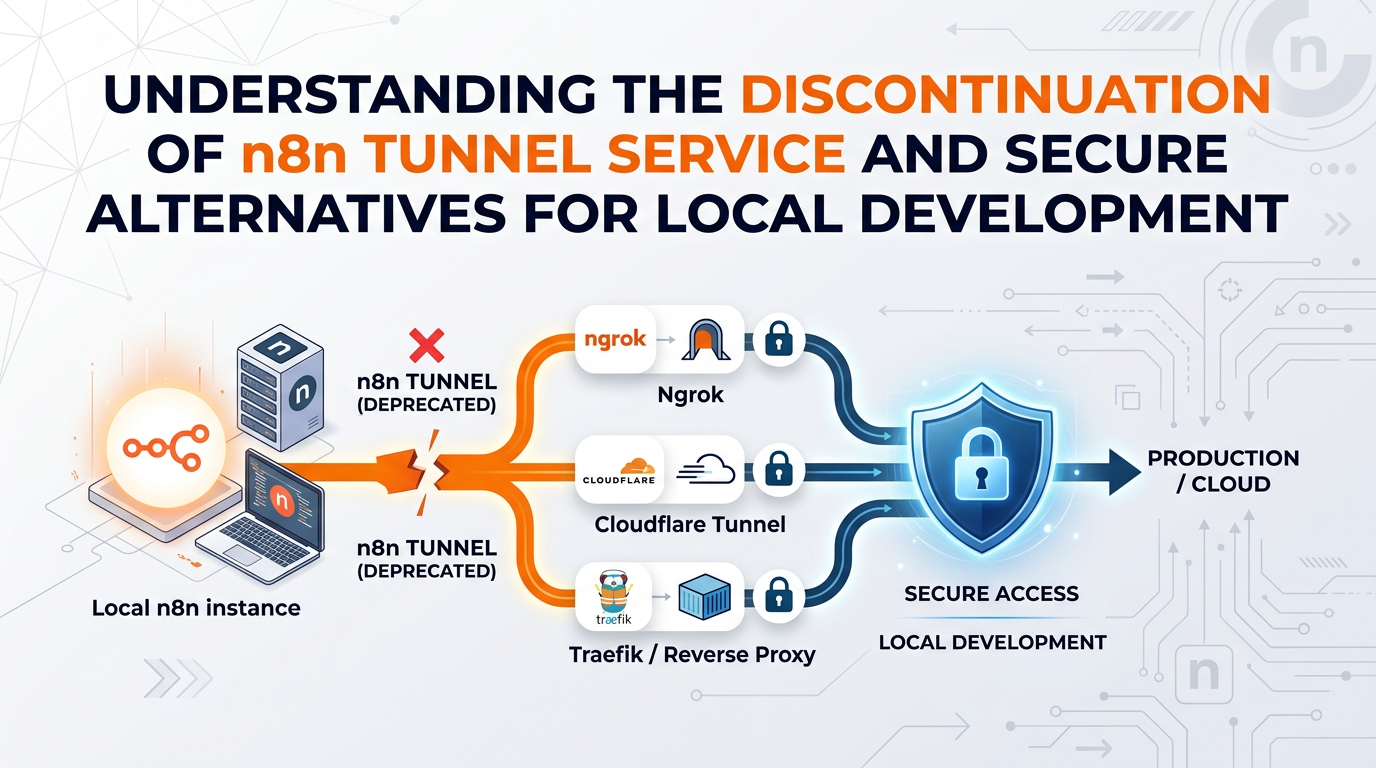
Tunnel services are the primary method for gaining remote access to local server environments during web app development. By exposing local servers to the public internet, they enable critical testing of webhooks, integrations, and live demonstrations. Such convenience accelerates development cycles; however, it sometimes compromises security and stability. The n8n tunnel service catered primarily to basic local testing. Due to increased security concerns and scalability challenges, n8n’s decision-makers chose to discontinue the tunnel option to encourage adoption of more secure, reliable, and industry-standard solutions.
Step-by-Step: Setting Up a Secure Port Forward
To find an ngrok alternative and replace the n8n --tunnel option, you can use a simple SSH command if you have access to a remote VPS. The syntax typically looks like ssh -R 80:localhost:5678 user@your-remote-server. This command tells the remote server to listen on port 80 and forward all incoming traffic to port 5678 on your local machine, where n8n is usually running. This setup is significantly more secure than the old n8n tunnel because it leverages your own SSH keys for authentication. Furthermore, it eliminates the middleman, ensuring that your data only passes through infrastructure you control. For developers in Israel managing sensitive data, this level of infrastructure sovereignty is a major upgrade over generic tunnel services.
Enhancing Infrastructure Sovereignty in Israel
For many Israeli startups and established tech firms, data sovereignty is a regulatory and operational requirement. Moving away from external tunnel providers toward a self-managed architecture for secure data tunneling (מנהור נתונים מאובטח) allows teams to keep their development traffic within their own controlled cloud environment (such as AWS, GCP, or local Israeli providers). This minimizes the 'supply chain' risk where a breach at a third-party tunnel provider could expose local development environments. By configuring your own SSH-based tunnels, you ensure that your internal development services (שירותים לפיתוח) remain strictly under your own security policy and jurisdiction.
Why SSH is the Standard for Secure Data Tunneling (מנהור נתונים מאובטח)
In the modern development ecosystem, the ability to grant remote access to local server environments is no longer just a convenience—it's a requirement. Whether you are debugging complex webhooks from a SaaS provider or demonstrating a work-in-progress to a client, you need a bridge between your local machine and the public web. Relying on a deprecated service n8n tunnel (שירות n8n tunnel) can expose your local development environment to unnecessary risks. By shifting to professional secure data tunneling (מנהור נתונים מאובטח) with SSH, you ensure that your local server remains accessible only through encrypted channels, preventing unauthorized traffic and potential data breaches. This is especially critical for developers using advanced development services (שירותים לפיתוח) in Israel, working on high-sensitivity projects in fintech or healthcare, where local development environments must mirror production security as closely as possible.
Security Considerations and Beyond
Moving away from the built-in tunnel service aims to ensure developers adopt modern security practices. Public URLs accessible without robust protections introduce risks, including unwanted traffic and potential data misuse. The discontinuation encourages reliance on alternatives better suited for secure testing and production. Additionally, maintaining a public-facing tunnel service involves significant overhead in performance, security monitoring, and updates. By focusing on core functionalities, n8n streamlines its services and advocates for trusted third-party tunneling solutions. Implementing SSH port forwarding is particularly relevant to Israeli enterprises, including banks, hospitals, and logistics companies, which handle sensitive data and require stringent cybersecurity standards.
Optimizing Development Services for Israeli Tech Standards
In Israel's high-tech ecosystem, security is not optional. The shift from the legacy n8n tunnel service (שירות n8n tunnel) to more professional tools reflects a broader trend in development services (שירותים לפיתוח) toward zero-trust architecture. An ngrok alternative that utilizes SSH keys ensures that only authorized traffic can hit your local development (פיתוח מקומי) instance. Whether you are building automation on n8n or testing microservices, implementing a self-hosted tunnel solution aligns your local environment with the rigorous security protocols used by leading Israeli enterprises in cyber and finance.
Implications for Your Workflow
Developers working with integrations requiring webhook notifications face challenges in continuing local testing without disruption. Key considerations include:
- Local to Public Transmission: Transition to trusted tunneling services or cloud environments in place of the deprecated n8n tunnel.
- Security Best Practices: Re-evaluate security frameworks, adopting solutions aligned with stringent requirements to protect sensitive data.
- Improved Reliability: Third-party services or custom setups typically offer superior uptime and stability compared to the discontinued tunnel.
Organizations like does.center in Israel specialize in providing secure remote access to local server solutions for automation projects, ensuring that the transition to new services is seamless and maintains high security standards.
Exploring Alternatives and SSH Port Forwarding
When you need reliable remote access to local server instances for local development (פיתוח מקומי), several third-party tunneling services offer superior security and stability. Below are the top industry-standard options:
Critical Factors When Choosing a Remote Access Tool
When selecting a tool for remote access to local server setups, you must evaluate more than just ease of use. Consider the following: 1) Encryption: Does the tool provide end-to-end TLS encryption? 2) Persistence: Do you need a static URL that stays the same every time you restart your local server? 3) Inspection: Can you inspect the incoming HTTP requests to debug your webhooks in real-time? Tools like Ngrok excel in these areas, making them the preferred choice for professional פיתוח מקומי. For those who prioritize open-source transparency, LocalTunnel remains a strong contender. Transitioning to the SSH Tunneling protocol (פרוטוקול SSH Tunneling) or managed services ensures your פיתוח מקומי workflow remains uninterrupted and professional.
Manual SSH Tunneling vs. Managed Services
While tools like Ngrok and LocalTunnel provide an easy-to-use interface, manual implementation of the SSH Tunneling protocol (פרוטוקול SSH Tunneling) offers the highest level of transparency and cost-efficiency. By utilizing a simple cloud instance, developers can establish a persistent and private tunnel that does not rely on third-party infrastructure. This is ideal for Israeli tech teams who prioritize data sovereignty and need a reliable method to test automation scripts without exposing internal IPs. Whether you choose a manual setup or a managed provider, the shift toward standardized tunneling protocols is a major upgrade in security over legacy built-in tunnel features.
A. Ngrok
Ngrok is a widely-used tunneling service providing encrypted tunnels to your local environment with minimal setup. After creating an account, simply download the client, authenticate, and establish public tunnels. Benefits include:
- Encrypted HTTPS tunnels ensuring secure data transfer.
- Traffic inspection via a detailed dashboard aiding debugging.
- Custom subdomains and reserved domains available on paid plans.
B. LocalTunnel
LocalTunnel is a straightforward, open-source tool allowing quick sharing of local servers through public URLs. It’s ideal for rapid testing and demos with advantages such as:
- Simple terminal commands to create a public URL.
- Community transparency and contributions due to open-source nature.
- Lightweight setup suitable for smaller projects.
C. Self-Hosted Solutions
For higher security and customization, self-hosted tunnels (e.g., Auth0 Tunnel or reverse proxies on secure servers) offer:
- Full control over configuration, including authentication, rate limiting, and logging.
- Compliance alignment with standards like GDPR or HIPAA.
- Scalable infrastructure adaptable to growing project demands.
Such solutions are increasingly adopted by Israeli research institutions and enterprises seeking tight control over data flows and compliance.
Implementing a New Workflow: Step-by-Step
Transitioning from the n8n tunnel service can be streamlined with this approach:
- Assess Your Needs: Identify how the tunnel was used—quick testing or critical development—to choose the best alternative.
- Choose the Right Alternative: Opt for LocalTunnel for simple testing, Ngrok or self-hosted setups for production-level demands considering team expertise and support.
- Update Your Configuration: Modify environment variables, config files, and documentation to integrate the new tunnel.
- Test Thoroughly: Validate connection reliability and webhook functionality before the full switch.
- Document Everything: Ensure all team members have clear instructions, troubleshooting steps, and architecture diagrams.
Why Professional Remote Access Enhances Local Development
Although initially inconvenient, switching offers long-term advantages:
- Enhanced Security: Adherence to modern encryption and security standards reduces unauthorized access risks.
- Increased Reliability: Dedicated services maintain higher uptime and better monitoring.
- Greater Transparency: Tools like Ngrok provide traffic analytics for improved debugging and performance analysis.
- Scalability: Robust services facilitate growth from local testing to production deployment.
Conclusion
The retirement of the n8n Tunnel Service is a significant shift encouraging developers to adopt more secure, stable, and scalable tunneling solutions. Whether you select Ngrok, LocalTunnel, or a self-hosted option, the focus is now on stronger security and optimized development workflows. Embrace this change to improve your development process, safeguard your data, and gain valuable insights into your application's operation. With the right tools and a clear plan, transitioning away from the n8n tunnel can ultimately enhance both team efficiency and end-user experience. This evolution aligns well with trends seen in Israeli automation initiatives and enterprise sectors supported by providers such as does.center, reflecting a global push towards security-conscious development practices.