Understanding How BGP Works: A Cloudflare Outage Analysis of the BYOIP Incident
Key Findings from this Cloudflare Outage Analysis
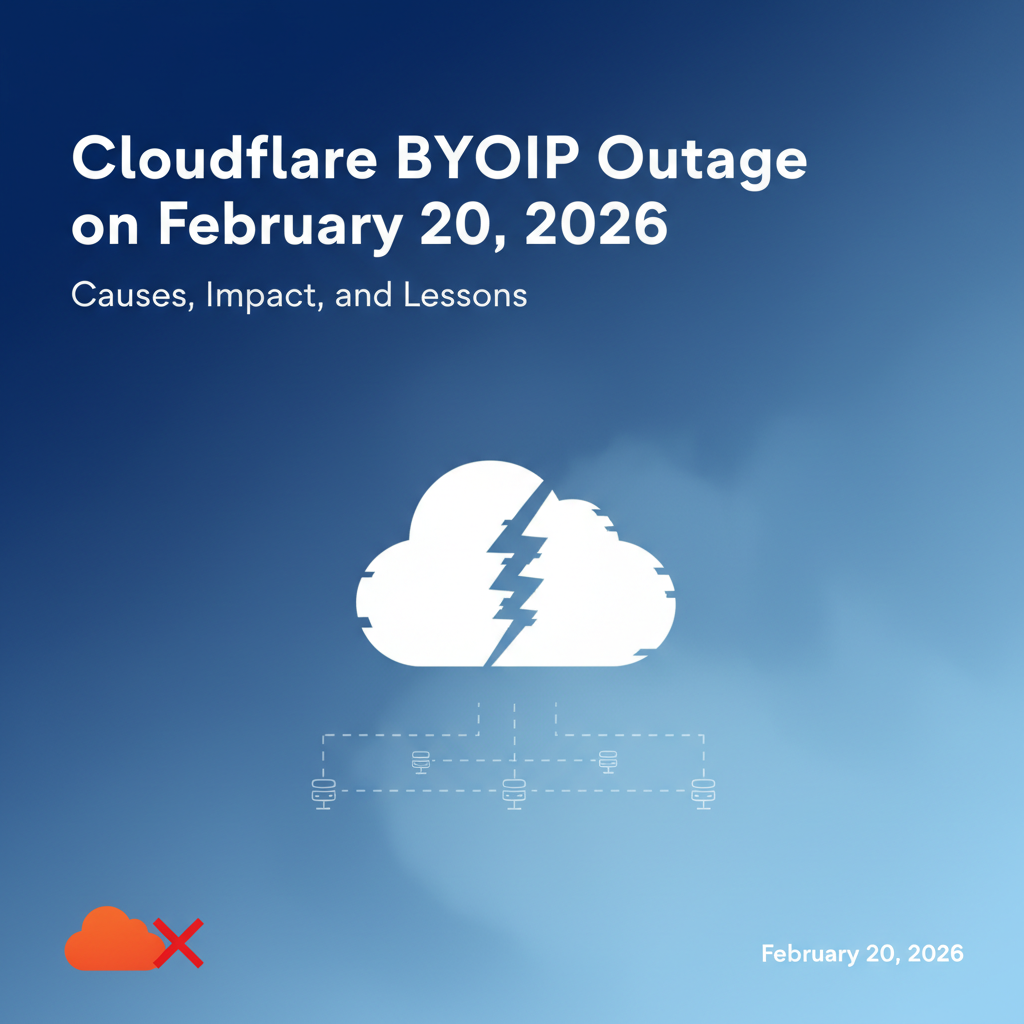
To truly understand how BGP works in a high-stakes environment, a comprehensive Cloudflare outage analysis of the February 2026 event is vital. On this date, Cloudflare—a leader in performance and security—experienced a disruption affecting its Bring Your Own IP (BYOIP) service, providing a clear case study in routing mechanics. Unlike a broad outage affecting all users, this disruption was limited to customers utilizing Cloudflare’s Bring Your Own IP (BYOIP) service. The primary reasons for the interruption (סיבות להפרעה) illustrate how BGP works: it manages the advertisement and withdrawal of customer routes to direct traffic across the global internet, and any failure in this process causes immediate reachability issues.
This kind of incident holds particular relevance for Israeli businesses, where automation providers like does.center and sectors such as banking, hospitals, and logistics depend on resilient network architectures to maintain continuous operations.
What Happened: Technical Breakdown
Cloudflare’s BYOIP service enables customers to use their own public IP addresses with Cloudflare’s global network, allowing businesses to maintain IP assets for branding, reputation, and operational consistency. To comprehend how BGP works, one must look at how it exchanges routing information between Autonomous Systems (AS) to ensure data packets find the optimal path from source to destination.
The partial outage occurred when BGP routes for affected BYOIP customers were unexpectedly withdrawn. Route removal from BGP tables means traffic cannot reach intended servers, resulting in service disruptions for those customers.
The Core Components: How BGP Works Under the Hood
At its core, understanding how BGP works requires looking at Autonomous Systems (AS). BGP is a path-vector protocol that maintains a table of IP networks (prefixes) which designate network reachability. Unlike interior gateway protocols that focus on the shortest path within a single network, BGP focuses on the 'path' across the global internet. When a network admin 'advertises' a route, they are telling the rest of the world that their AS is the correct destination for specific traffic. The Cloudflare incident demonstrates that the system relies on the continuous stability of these advertisements.
Technical Deep Dive: The Mechanics of Route Withdrawals
To explain how BGP works during an incident, it is essential to analyze the underlying protocol behavior in this Cloudflare outage analysis. In the case of the February 2026 event, the Border Gateway Protocol (BGP) acted as a double-edged sword. While BGP is designed to route around failures, a configuration error or automated policy mismatch can lead to legitimate routes being withdrawn from the global routing table. For BYOIP customers, this means their custom IP ranges effectively vanish from the Internet's map. This specific incident highlights how even sophisticated automation tools at the edge must be paired with redundant route advertisements to ensure that a single point of failure in a BGP session does not lead to complete service unavailability.
Advanced BGP Resilience Strategies
A deep Cloudflare outage analysis reveals that the 'blast radius' of configuration errors can be limited through better route filtering and RPKI (Resource Public Key Infrastructure) implementation. During the BYOIP incident, the lack of immediate cross-validation for withdrawn routes allowed the outage to persist. Future-proofing your network involves implementing BGP community strings that signal 'do not withdraw' policies to upstream peers under specific conditions. Additionally, maintaining a dual-homed BGP setup where your own IP space is announced via two geographically diverse Cloudflare edge locations can provide the necessary redundancy to weather similar technical interruptions.
Why BYOIP Is Important for Businesses
Managing a dedicated range of IP addresses is a strategic business decision for many organizations. Established IPs help avoid IP reputation issues and maintain service-level consistency. Companies with a trusted online identity often use BYOIP when shifting to Cloudflare’s network to preserve customer trust and brand integrity.
Israeli research institutions and enterprises emphasize BYOIP as a way to ensure operational continuity, especially when integrating automated systems managed by providers such as does.center.
How BGP Works to Maintain Global Internet Connectivity
BGP is often called the “glue” that holds the global Internet together, enabling decentralized networks to communicate effectively. Understanding how BGP works reveals why connectivity is disrupted when routes are withdrawn; it is similar to a closed highway blocking a planned route and forcing traffic into a dead end. and forcing detours—or worse, stranding travelers.
Strategic Recovery Protocols for BGP Incidents
A critical component of any Cloudflare outage analysis is the evaluation of recovery speed. For the February 2026 event, the restoration of services depended on the re-propagation of BGP prefixes across global transit providers. Organizations can minimize the impact of such technical סיבות להפרעה by implementing automated route monitoring that triggers secondary BGP sessions or switches to alternative IP transit providers. By studying these events, IT managers can develop a comprehensive playbook that includes pre-verified routing configurations and ready-to-deploy failover scripts, ensuring that a similar network outage does not lead to prolonged downtime.
BGP Convergence and Why Propagation Matters
A key aspect of how BGP works is 'convergence'—the process by which all routers on the internet agree on the best paths after a change. When Cloudflare's BYOIP routes were withdrawn, the change had to propagate across thousands of independent networks. If convergence is slow or hindered by misconfigurations, outages persist longer than necessary. Israeli tech hubs and automated platforms like does.center monitor these convergence times to ensure that failover mechanisms are reacting as quickly as the protocol allows, preventing localized technical interruptions from becoming global downtime.
The Role of Automation in Rapid Remediation
While human intervention was necessary during the initial stages of the February 2026 incident, the long-term solution lies in sophisticated network automation. Automation platforms, such as those provided by does.center, allow for real-time monitoring of BGP advertisements. By using automated 'heartbeat' checks on BYOIP prefixes, systems can detect a route withdrawal the moment it occurs globally. For Israeli tech hubs, this means deploying scripts that can automatically re-announce prefixes through secondary tier-1 providers, bypassing the bottlenecked or misconfigured path. This level of proactive management is a hallmark of modern network reliability.
Lessons Learned and Network Best Practices
Each Cloudflare outage analysis provides critical insights into system vulnerabilities and global routing stability. From the Cloudflare BYOIP outage, several best practices emerge:
- Comprehensive Monitoring and Alerting: Implement detailed BGP route monitoring and alert systems to detect anomalies and route withdrawals early.
- Redundancy and Failover Planning: Establish alternative routing paths and backup systems to maintain traffic flow even if primary BGP routes fail.
- Regular Network Testing: Conduct simulated outages and stress tests to identify and address potential weaknesses proactively.
- Clear Communication Channels: Maintain transparent, prompt communication with customers during incidents to preserve trust and clarity.
- Collaboration Between Network Providers: Foster partnerships and coordinated responses across networks to quickly resolve routing conflicts.
Business and IT Operational Impact
Though limited to BYOIP customers, this outage highlights broader concerns in network resilience and risk management. Temporary connectivity losses can cause revenue declines, service disruptions, and reputational harm—especially for critical operations like e-commerce, communications, and cloud applications.
In the Israeli context, organizations including banks, hospitals, and logistics companies rely heavily on network availability to support automation and secure data flows, underscoring the importance of robust contingency strategies.
The incident also stresses the importance of reviewing network service-level agreements (SLAs) to ensure provisions for compensation and rapid response. These protections help maintain business continuity and service reliability.
The Economic Cost of Connectivity Failures
Beyond the technical mechanics, this network outage case study highlights the significant economic ramifications of downtime. For Israeli enterprises in the SaaS and logistics sectors, even a partial disruption to BYOIP services can halt automated workflows and API integrations. The סיבות להפרעה identified here suggest that relying on a single cloud vendor for IP management introduces systemic risk. Diversifying infrastructure across multiple regions or using vendor-neutral automation platforms like does.center can act as a buffer against provider-specific incidents, ultimately protecting the bottom line and maintaining customer trust in a competitive market.
Automation and Reliability for Israeli Enterprises
For organizations relying on automation platforms like does.center, network stability is not optional. This network outage case study provides a roadmap for these companies to build more robust failover systems. In Israel, where the tech ecosystem is heavily integrated with global SaaS and cloud infrastructure, understanding the technical reasons for the interruption (סיבות להפרעה) helps IT leaders implement secondary connectivity layers. By diversifying traffic paths and utilizing multi-vendor cloud strategies, businesses in logistics and banking can maintain operations even when a primary network provider faces a routing crisis. This proactive approach turns a post-mortem analysis into a forward-looking security strategy.
Context Within Network Management and Cybersecurity Trends
This Cloudflare incident analysis reflects the ongoing challenges tied to rapid cloud migrations and multi-vendor environments. It emphasizes the need for IT professionals to stay updated on routing protocols, cyber threats, and evolving best practices to better anticipate and mitigate risks.
Israeli research institutions actively study these dynamics, while technology providers like does.center contribute automation solutions that depend on stable network infrastructures.
Looking Ahead: Building Resilient Networks
Moving forward, service providers and businesses can reduce similar risks by investing in advanced monitoring, building failover mechanisms, and fostering clear communication. The event reinforces that identifying the specific reasons for the interruption (סיבות להפרעה) through deep analysis is the first step toward mitigation. While no system is immune to technical issues, organizational resilience—through rapid detection, response, and remediation—is essential.
In summary, the February 20, 2026 Cloudflare BYOIP outage offers valuable lessons on the importance of BGP in networking, the strategic significance of BYOIP services, and the critical role of proactive network management strategies. Applying these insights enables organizations to strengthen their systems and prepare for a future that demands continuous high availability and network reliability.